
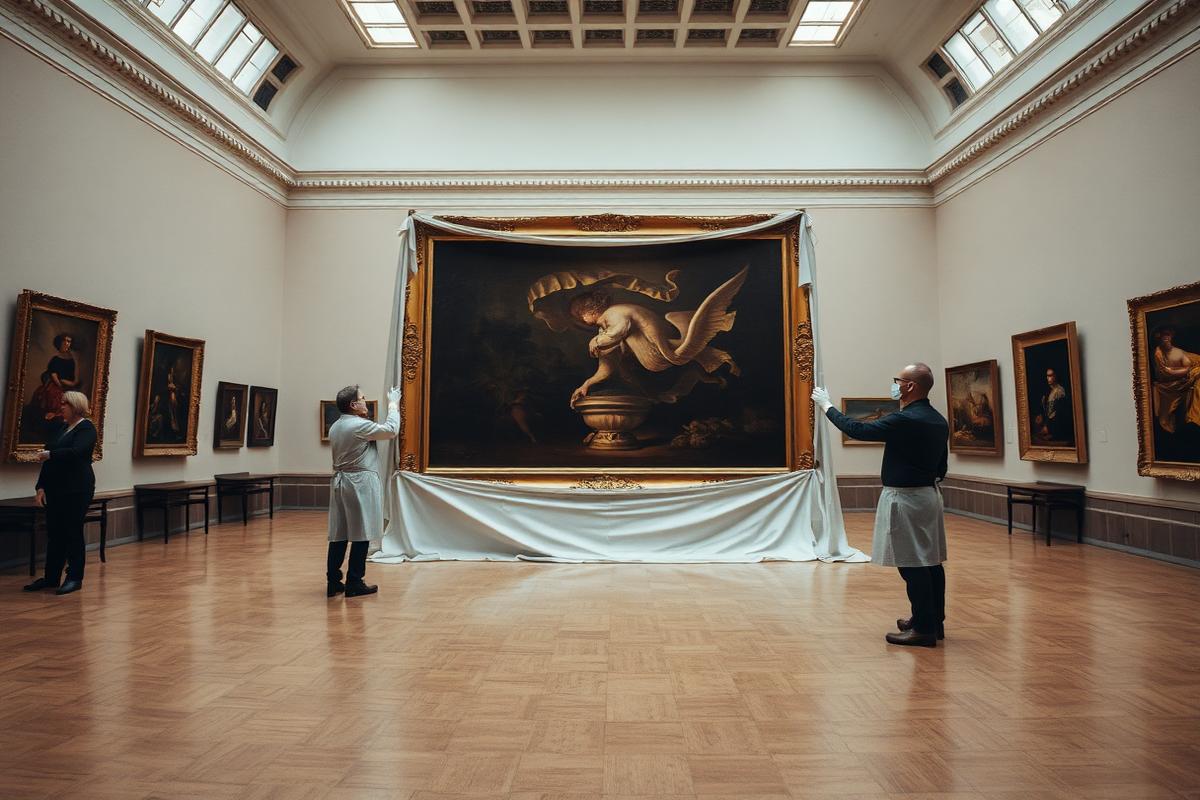
FLORENCE, Italy — For more than a century, visitors who stood before the painting believed they were seeing it: a monumental canvas of a winged figure bent over an urn, rendered in browns and golds so dark the scene seemed to unfold at dusk.
It did not. On Thursday, after ten years of restoration and two centuries of accumulated grime, the Galleria dell'Accademia unveiled the work as its painter left it — a vision of luminous blues and flesh tones so vivid that several scholars who attended the closed ceremony admitted, later, to gasping.
“The varnish had yellowed so completely that we were, in effect, looking at a painting behind amber glass,” said Dr. Lucia Ferrante, who led the conservation team. “Every generation adds a film. We removed twelve.”
The restoration, funded by a private foundation and carried out in a laboratory built inside the museum, proceeded at a pace that frustrated donors and enthralled conservators: roughly a square inch a day. Under microscopes, technicians lifted each layer of varnish with solvents tuned, molecule by molecule, to dissolve the coating and spare the paint beneath.
What emerged solved old mysteries. A patch of sky long assumed to be storm cloud proved to be a brilliant ultramarine, painted with lapis more expensive than gold — evidence, Dr. Ferrante argues, of a patron whose identity has been debated for 150 years. Infrared scans revealed a second figure beneath the surface, painted out by the artist and never meant to be seen.
The unveiling also reopens an uncomfortable conversation. Cleaning old paintings is among the most contentious acts in art; every restoration removes not just dirt but a layer of history, and critics of the project warned for years that aggressive solvents might strip away the artist's final glazes. The museum has answered by publishing the complete scientific record — 4,000 pages of it — online.
The public will judge for itself beginning Tuesday, when the painting returns to its gallery. Attendance is expected to double, and the museum has already extended its hours. “People will come for the sensation,” Dr. Ferrante said. “I hope they stay for the question every great restoration asks: what, exactly, were we looking at before?”