
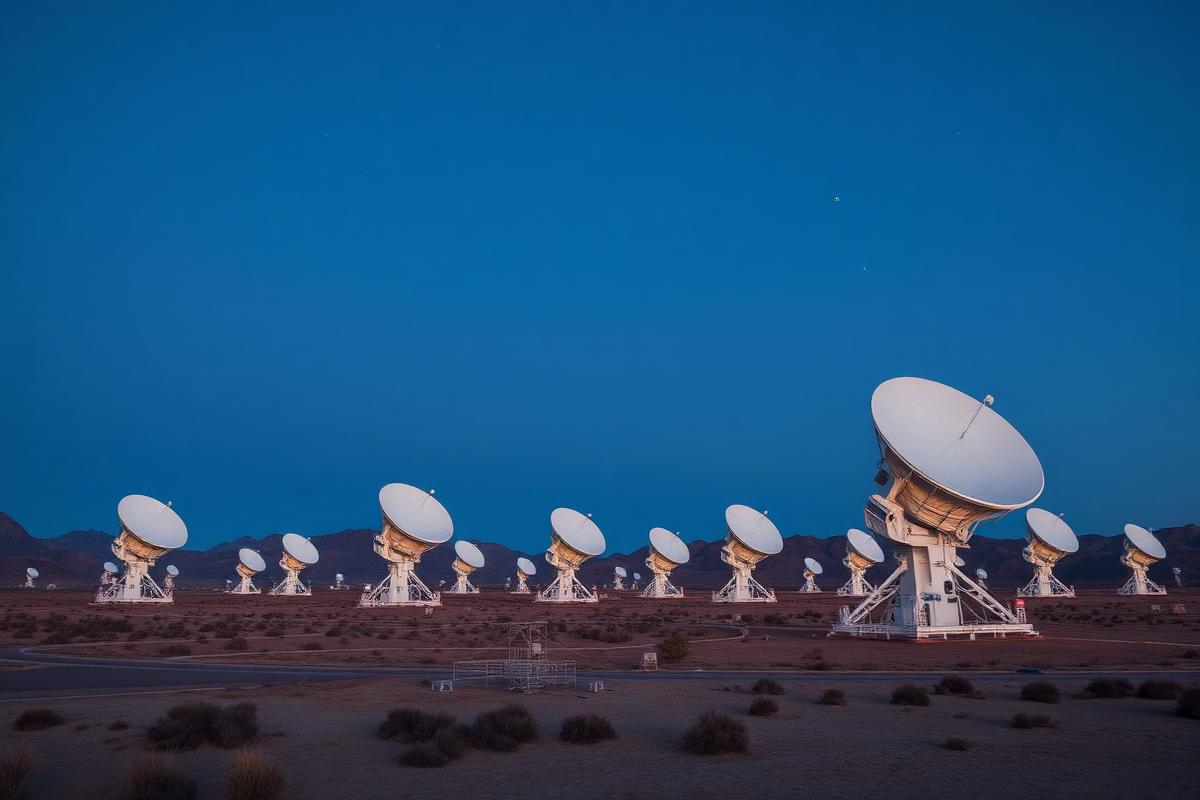
SOCORRO, N.M. — The signal arrived as it always does: a whisper of radio energy, lasting four seconds, repeating every 11 hours and 9 minutes with a precision that has now been confirmed by telescopes on three continents.
First detected in March by an array in the high desert outside Socorro, N.M., the pattern emanates from a red dwarf star some 40 light-years away — close, in cosmic terms, a next-door neighbor. In a paper published Friday in The Astronomical Journal, a team of 19 researchers laid out what they know, which is considerable, and what they do not, which is nearly everything else.
“We have ruled out instrument error, terrestrial interference and every known class of stellar flaring,” said Dr. Priya Ramanathan, the paper's lead author. “What remains is a short list of exotic natural explanations — and a responsibility to check each one carefully before anyone reaches for a more dramatic word.”
That word, which the paper conspicuously avoids, has nonetheless electrified the field. In the days since a preprint of the research appeared, observing time on the world's largest telescopes has been quietly reallocated, and at least four independent teams have turned their instruments toward the star, a dim object catalogued only as ROSS 248-b.
Astronomers stress that extraordinary caution is warranted. In 1967, a similarly regular signal discovered by Jocelyn Bell Burnell was half-jokingly labeled LGM-1, for “little green men,” before being identified as the first pulsar — a natural object no one had imagined. “The history of this science is the history of nature being stranger than our first guesses,” said Dr. Ramanathan.
The new signal, however, carries a puzzle pulsars do not: its pulses drift subtly in frequency in a way that tracks, the researchers found, the orbital motion of a planet around the star. “The source appears to be on or near a rocky world in the habitable zone,” said Dr. Felix Osei, a co-author. “That sentence took us four months to be willing to write.”
“It is either the most exciting artifact of nature we have ever found,” Dr. Osei added, “or the most exciting artifact, period.”
For now, the array outside Socorro keeps its silent vigil. Every 11 hours and 9 minutes, the whisper returns — patient, precise and, for the moment, unexplained.